A full feature wall is often expensive not because the stone is, but because joining it correctly wastes material, takes work, and goes wrong easily.
Turning two slabs into one continuous picture is called book-matching. Done well it is a feature wall; done badly it is two separately handsome slabs that do not meet. And whether it works is largely decided the moment the slabs are chosen — it is not something later fabrication can rescue.
What book-matching actually is
The method is to place two adjacent slabs from the same block side by side in mirror image, so the veining meets left to right like the pages of an open book. That is where the name comes from.
Two words matter here: adjacent, and mirrored. You will often see two slabs that merely “look similar” placed together and called a book-match. That is not one. The Natural Stone Institute’s definition is stricter — it is not only the same block, but the two faces that originally faced each other that must be polished, so the patterns are true mirrors. And this is normally done at the sawyer when the block is cut, not added later at a workshop: doing it later means re-polishing the back of one slab, at more cost and without a guaranteed result.
Why the same block is essential
This is the one condition book-matching cannot bend. Whites from different blocks differ in veining direction and grey tone, and forcing them together leaves a visible break at the seam that anyone can spot.
So book-matching is normally reserved at the source: at the quarry or block stage, adjacent slabs from the same block are picked out and marked for the job. By the time you are choosing in a showroom it is usually too late — most stone is cut mixed, and the adjacent piece is hard to find again.
Which varieties suit it
In one line: the more directional the veining and the more picture-like the figure, the more striking the book-match.
Arabescato is one of the first choices — dark grey vine figures on a grey-white ground that mirror into symmetrical foliage, strongly decorative. Its select version, Arabescato Corchia, is even more pronounced: grey veining layered like mountain ranges, so a whole wall becomes a landscape, which is also where it is most used.
Calacatta Oro works well too, its bold gold and grey veins forming symmetrical golden lines when matched. Calacatta Viola interweaves purple-grey and pale gold for the most layered result — though note, Bulgari White is a trade name, not a standard industry variety.
Conversely, the clean types, Bianco Carrara and Statuario Venato, are poorly suited to book-matching. The veining is too even for the match to read, and an ordinary running vein layout is both sufficient and more economical.
Three ways to join
The trade names three, with different effects and uses.
Book-matching is left-right mirror symmetry, like an open book, and suits directional veining such as Arabescato Corchia, Arabescato and Calacatta Oro.
Vein-matching lets the veining run across the seam without breaking, and suits large continuous areas or a quiet full wall.
Diamond or quad matching mirrors four pieces into one complete pattern, for larger main walls or screen-style features.
| Layout | Effect | Best for |
|---|
| Book-match | Left-right mirror symmetry, like an open book | Arabescato Corchia, Arabescato, Calacatta Oro |
| Vein-match | Veining continues across, no break | Large continuous areas, quiet full walls |
| Quad match | Four mirrored slabs form one complete pattern | Large main walls, screen-style features |
Layout and fabrication: the easy places to slip
Set the size first, then choose slabs. Give us the net dimensions of the wall — including where cut-outs go and where the joint should sit — and we will work out how many slabs and how to cut them. Do it in the other order and you risk finding the stone does not cover the wall after it arrives.
Book-matching wastes more material than vein-matching, because mirroring cuts some away. For large-format walls we suggest allowing 10–15% over the measured area.
The joint position has to be fixed at the layout stage. The book-match joint usually sits at the centre and is visually the most important line, so it must land exactly where the design wants it.
Then fabrication and installation. For large feature walls, add reinforcing mesh or backing strips, make cut-outs (sockets, lights) to drawings, and hand it to an experienced large-slab team.
How Jiecheng Stone helps
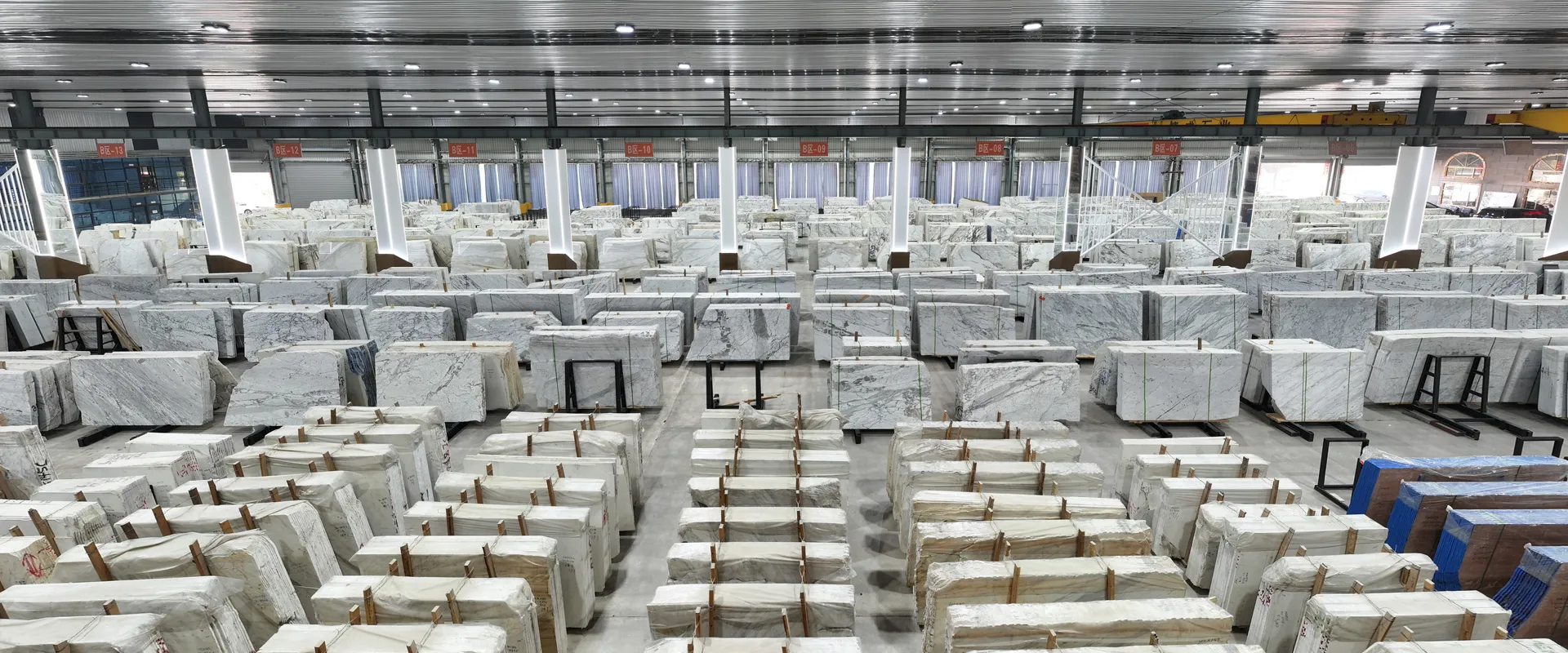
Jiecheng Stone deals in Italian light-luxury white marble. We hold the largest stock of Arabescato in Fujian, and Arabescato Corchia, Calacatta Oro and Calacatta Viola are kept year-round. Blocks come straight from the Carrara region and are sawn, polished and resined at our own 80,000 m² factory in Shuitou.
The part of book-matching that matters most — reserving slabs from the same block — we do at intake: slabs from one block are tagged and tracked. Every slab is scanned into the Cloud Warehouse, so you can first view adjacent slabs from the same block side by side online, judge whether the match works, and then reserve specific bundle references for shipping.
Send us the net wall dimensions and the variety you want, and we will propose a feasible book-match plan and pull up the matching stock slabs.