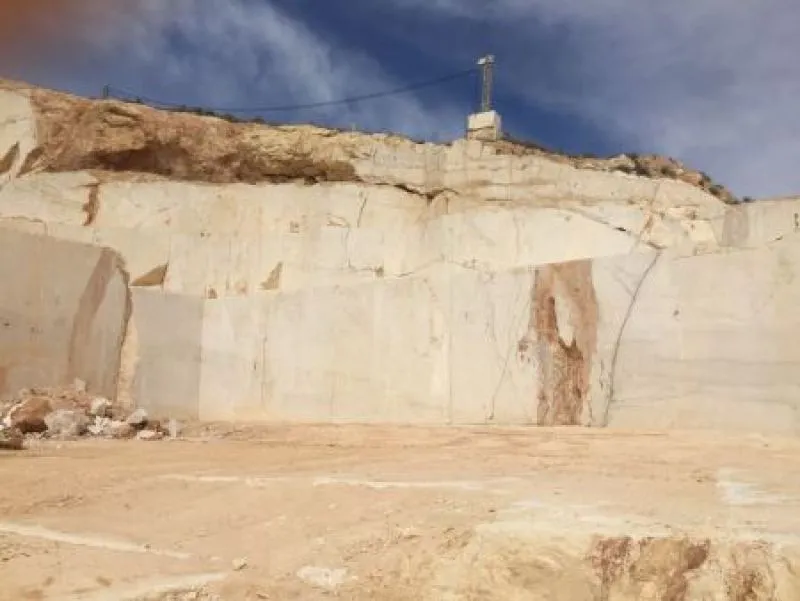
White marble reaches a project in one of two forms: slabs, or blocks.
A slab is already sawn and surfaced, ready for a fabricator to cut to size; a block is raw stone from the quarry that still has to be sawn. Which you need depends on the job, and the buying process differs quite a bit.
Buying slabs
Slabs are the finished product, so most interior and fit-out projects want them — already thin, flat and consistent.
Start with size: length, width and thickness. On thickness, common metric thicknesses are 1.6, 1.8, 2 and 3 cm; US standards are 19 mm and 32 mm, and 19 mm slabs used as worktops are normally laminated at the edge. The larger the slab, the fewer joints you see.
Then the finish — polished, honed or brushed, chosen by application. If two slabs are to be book-matched into one picture, they must come from the same block; there is no way around that. On quantity, allow 10–15% over the measured area for cuts, book-matching and future repairs.
Because slabs are already finished, the whole order can mostly be approved from photographs. We still advise looking at the actual slab: every slab in stock carries a scan and dimensions, so you can check piece by piece before shipping.
Buying blocks
Blocks suit buyers who will saw and surface the stone themselves, or who need a non-standard thickness. Their size is set by the quarry and by the block itself, not by a catalogue — they are usually delivered by the cubic metre, and each one differs.
When you buy a block you are buying three things. Volume, priced by m³ with each block dimensioned. Grade and soundness — how free of cracks it is, and how even the colour and veining are through the mass. And yield, the realistic ratio of finished slab to block volume: a sound, well-graded block yields far more than a cracked one.
Honestly, yield is best judged by someone who looks at actual blocks every day. We mark and track blocks from the quarry to the yard, and can advise on the expected yield of a specific block.
Packing and shipping (what applies to both)
Slabs are packed in fumigated wooden crates or frames and secured with steel straps, then loaded into 20-ft or 40-ft containers, or consolidated as LCL. The timber packing must comply with ISPM 15. One detail: never strap white stone with straw rope — it bleeds and stains white slabs yellow, an old lesson in this trade.
One point that runs against intuition: because stone is dense, exports generally prefer 20-ft containers. A 40-ft container of stone very easily exceeds the weight limit; slabs over 1.8 m tall usually move in an open-top instead.
From our yard the route is short: the factory is 40 km from Xiamen Port and 20 km each from Xiamen Xiang’an International Airport and Quanzhou Jinjiang Airport, so finished stone can be packed and shipped without a long inland haul.
Which should you buy?
Need stone for installation, in standard thicknesses, book-matched to a design: buy slabs. Will saw and surface it yourself, or need a special thickness: buy blocks.
If you are not sure, send us the finished dimensions and the look you want, and we will tell you which suits the project and roughly what it should cost.
Current slab stock can be browsed in the Cloud Warehouse; for block availability, just contact us.