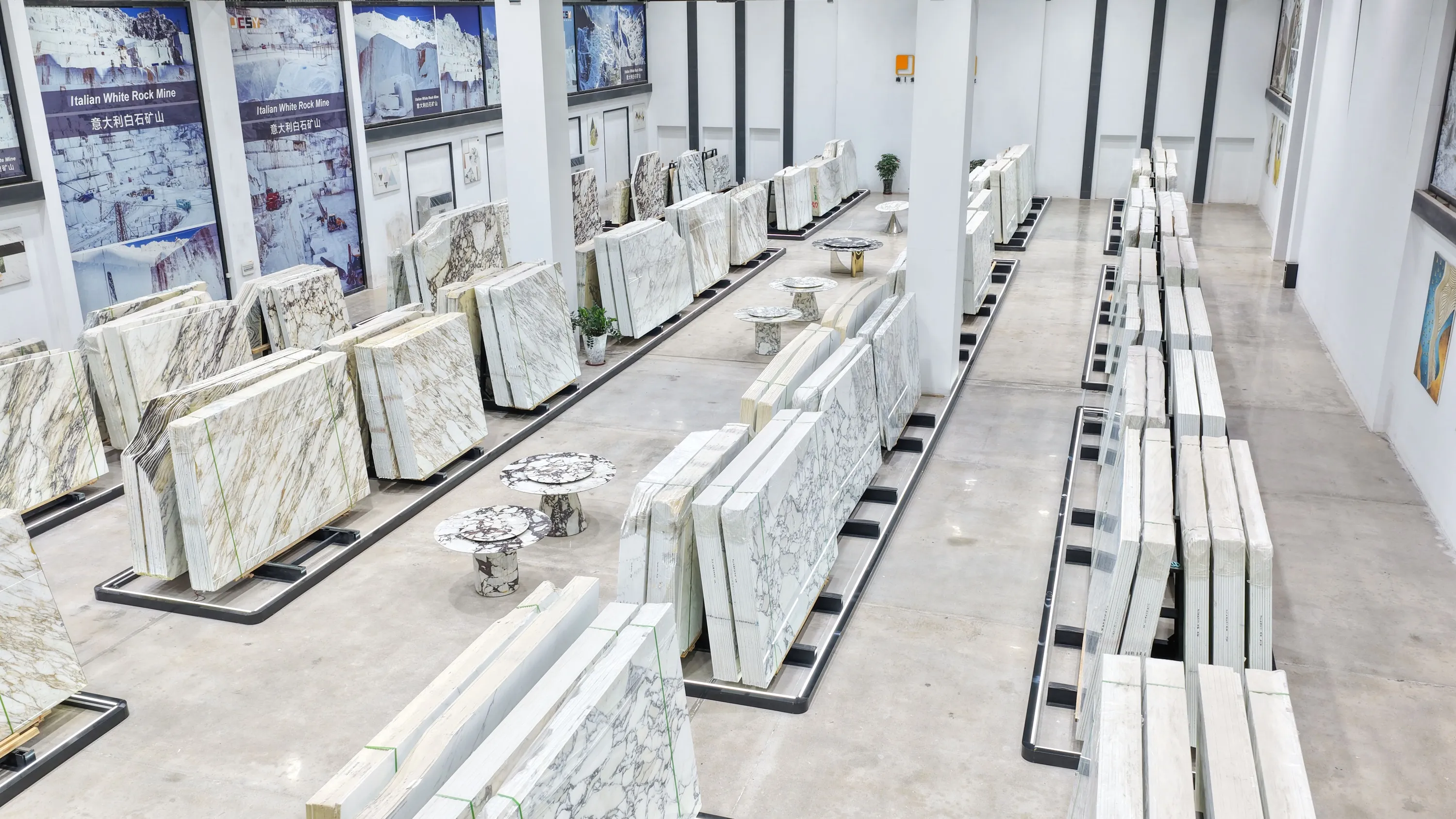
The two rooms that use most white marble are the kitchen and the bathroom, and they ask almost opposite things of the stone: the kitchen faces oil, acid, heat and scratching daily, while the bathroom faces water, humidity and slip resistance. Choosing the right variety and finish matters more than choosing the expensive one.
Kitchen: stain and acid resistance first
The worktop is the hardest-working surface in the kitchen. One premise has to be accepted first: white marble is softer and more porous than granite or quartz — in exchange for its look and veining, it asks for more care. And it fears acid, so lemon juice, wine and vinegar must be wiped off promptly; a sealer prevents staining but not etching.
On variety, warm tones and gold veining read best in a kitchen. Calacatta Vagli pairs a warm white ground with a grey-gold web and is a perennial choice for islands and worktops. Bianco Carrara is cool, clean and good value when budget leads. Volakas White brings a milky ground with grey-brown diagonal veining and looks contemporary.
On finish: a polished worktop is easier to wipe clean and shows the veining more strongly; if water marks and fingerprints bother you, honed is quieter. Though note — in the trade, honed is more often recommended for worktops, because if there is ever an etch mark, a matt surface shows it least.
On thickness: worktops are normally 1.8 or 2 cm, with a thicker 3–4 cm front edge built up by the fabricator; on a wide island, add a sub-top or reinforcing strips.
Bathroom: slip resistance and moisture control
A wet bathroom floor is the greatest safety risk. Use honed or brushed for floors — the grip is noticeably better — and polished on walls and vanity tops, which are easy to clean and show the veining well.
On variety: Calacatta Vagli brings a warm, relaxing tone to a bathroom; Calacatta Viola, with its interwoven purple-grey and pale gold, makes a layered vanity or feature wall; for shower and floor areas where everyday wear shows, the fine threads of Bianco Carrara hide water marks best.
Two easy-to-miss points: in wet areas, keep joints to a minimum and get the waterproofing and grouting right; and because marble dislikes standing water, seal shower areas periodically.
Quick reference by part
| Space / part | Recommended varieties | Suggested finish |
|---|
| Kitchen worktop / island | Calacatta Vagli, Bianco Carrara, Volakas White | Polished (easy to wipe) or honed (fewer prints) |
| Kitchen floor | Bianco Carrara, Statuario Venato | Honed (slip resistance) |
| Bathroom vanity / walls | Calacatta Vagli, Calacatta Viola | Polished |
| Bathroom floor / shower | Bianco Carrara, Statuario Venato | Honed / brushed |
| Shower feature wall | Calacatta Viola, Calacatta Oro | Polished |
One note: Bulgari White is a trade name, not a standard industry variety — this white-ground, purple-grey and gold look is usually placed in the Calacatta Viola family.
How Jiecheng Stone helps
Jiecheng Stone deals in Italian light-luxury white marble, and the varieties kitchens and bathrooms use most — Calacatta Vagli, Bianco Carrara, Volakas White, Calacatta Viola — are kept in stock year-round. Blocks come straight from the Carrara region (Volakas from Greece) and are sawn, polished and resined at our own 80,000 m² factory in Shuitou.
We also offer cut-to-size, custom thickness and surface finish, and edge profiling to drawings (top cut-outs, edge profiles, reinforcing strips). Every slab is scanned into the Cloud Warehouse, so texture, size and bundle reference can be checked online.
Send us the finished dimensions of the worktop and walls, the variety and the finish you want, and we will confirm feasibility and show the matching stock slabs.