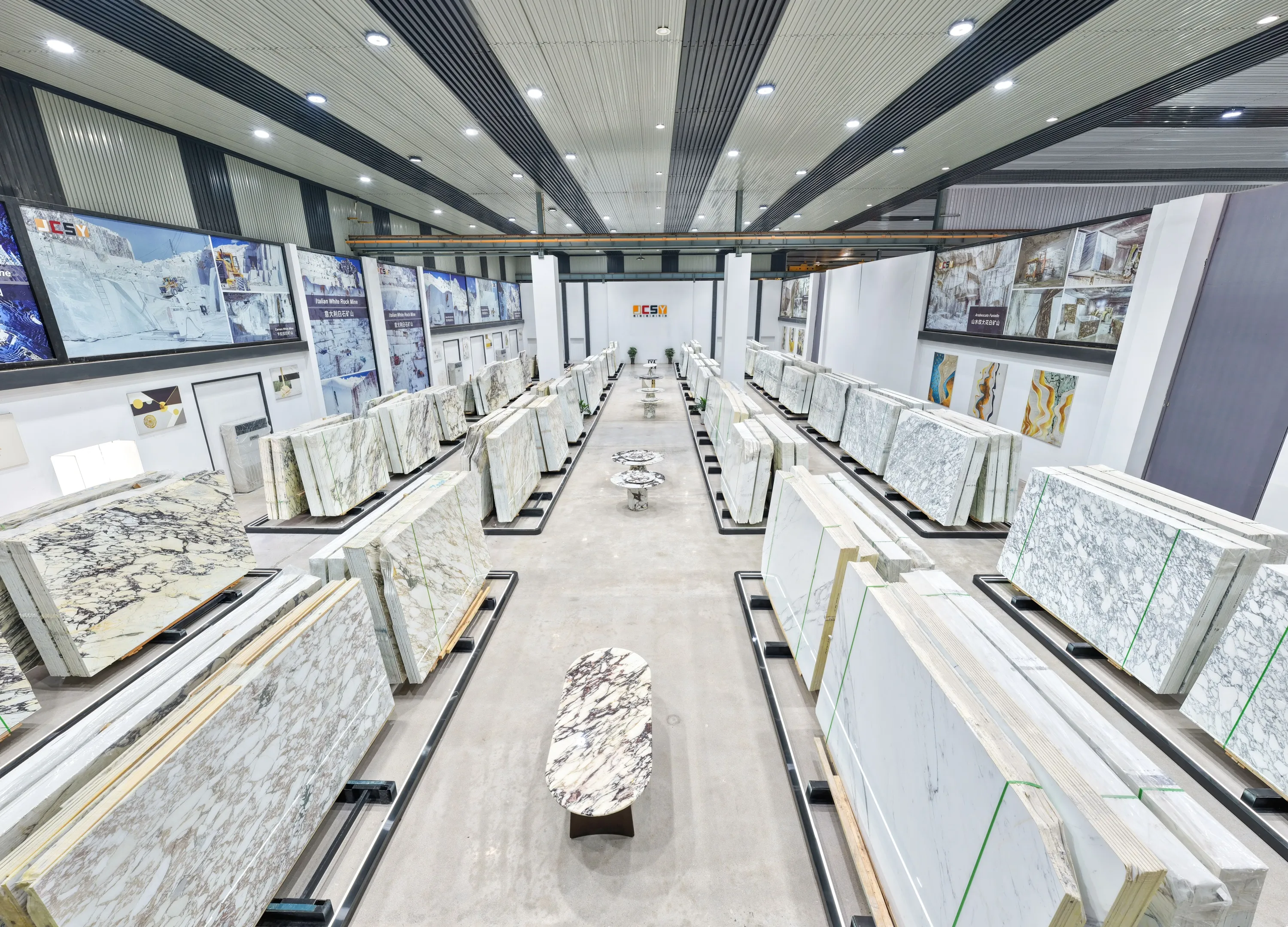
If the clean whites lay the groundwork, this group does the talking. What they share is strong veining or a warm base, and they are noticed the moment you walk in — which is why they are used differently: as one focal point, not across a whole floor.
Arabescato
A grey-white ground with dark grey, vine-like figures that spread freely, blocks and veins interwoven for vivid contrast. It is the most directly pictorial of the whites, at home on feature walls, floors and walls. We keep the largest stock in Fujian, so supply is relatively steady.
Arabescato is not one name but a family. In the trade it is split by Apuan quarry location: Arabescato Corchia, Cervaiole, Vagli and so on. One trap worth flagging: the similar-sounding Arabescato Orobico actually comes from Lombardy, is a dark grey breccia, and has nothing to do with Carrara — do not lump them together.
Arabescato Corchia
This is the select version: grey veining layered like mountain ranges, wide and commanding, often used across a whole feature wall. Its difference from ordinary Arabescato is the direction of the vein — a landscape rather than scattered figures. Corchia in the name is a real mountain and quarry district in the Apuan Alps, not an invented label.
Calacatta Oro
White crossed by bold gold and grey veins, distinctly golden and highly recognisable. When you want an instant high-end look, this is the most direct choice, common on feature walls, countertops and in bathrooms.
One practical point: oro is Italian for gold, so Calacatta Oro and Calacatta Gold are the same stone, and both names are correct.
Calacatta Viola (Bulgari White)
White with purple-grey figures interwoven with pale gold veins, richly layered, and much used in high-end interiors recently. Its opulence comes from the purple-grey and pale-gold combination, more subtle than plain gold veining.
One thing to say clearly: Bulgari White is a trade name, not a standard industry variety — there is no such marble variety in authoritative references, and on B2B platforms pink, red, black and white stones are all called Bulgari. This white-ground, purple-grey and gold look is usually placed in the Calacatta Viola family. Fine as a shop product name, but not as an industry variety.
Volakas White
A Greek classic: a milky ground with grey-brown veining running diagonally, like cloud drifting past — warm and modern. It is the only one here not from Italy, and the only “warm tone plus diagonal veining” pairing; well suited to walls, floors and bathrooms.
Volakas is in fact a village in northern Greece, and the stone takes its name from it — the same “named after the place” logic as the Arabescato family.
The five together
| Variety | Ground | Veining | Character | Best for |
|---|
| Arabescato | grey-white | dark grey vine figures | strongly decorative | feature walls, floors |
| Arabescato Corchia | grey-white | layered mountain veining | expansive | one full feature wall |
| Calacatta Oro | white | gold and grey veins | opulent | feature walls, tops, bathrooms |
| Calacatta Viola (Bulgari White) | white | purple-grey and gold | layered, rich | walls, bathrooms, tops |
| Volakas White | milky | diagonal grey-brown | warm, modern | walls, floors, bathrooms |
Using them well
These are hero stones, so the ratio matters: use one at a focal point and leave the large areas to the clean whites (Bianco Carrara, Statuario Venato) so the space can breathe. Covering a whole wall in strong veining reads busy instead.
To book-match two slabs into one picture, insist they come from the same block. The trade definition is strict — the same block, adjacent, and the two faces that originally faced each other polished, so the patterns are true mirrors; and this is normally done at the sawyer, not added later in a workshop.
The stronger the veining, the more you should look at the actual slab. Scattered figures and landscape-style veining are completely different effects, and photos differ from the real thing more than you would expect.
What we keep
We keep all five in stock year-round. Blocks come directly from partner quarries in the Carrara region (Volakas from Greece) and are sawn, polished and resined at our own 80,000 m² factory in Shuitou. Every slab is scanned into the Cloud Warehouse with its texture, size and bundle reference, so you can view it online and check piece by piece before shipping.