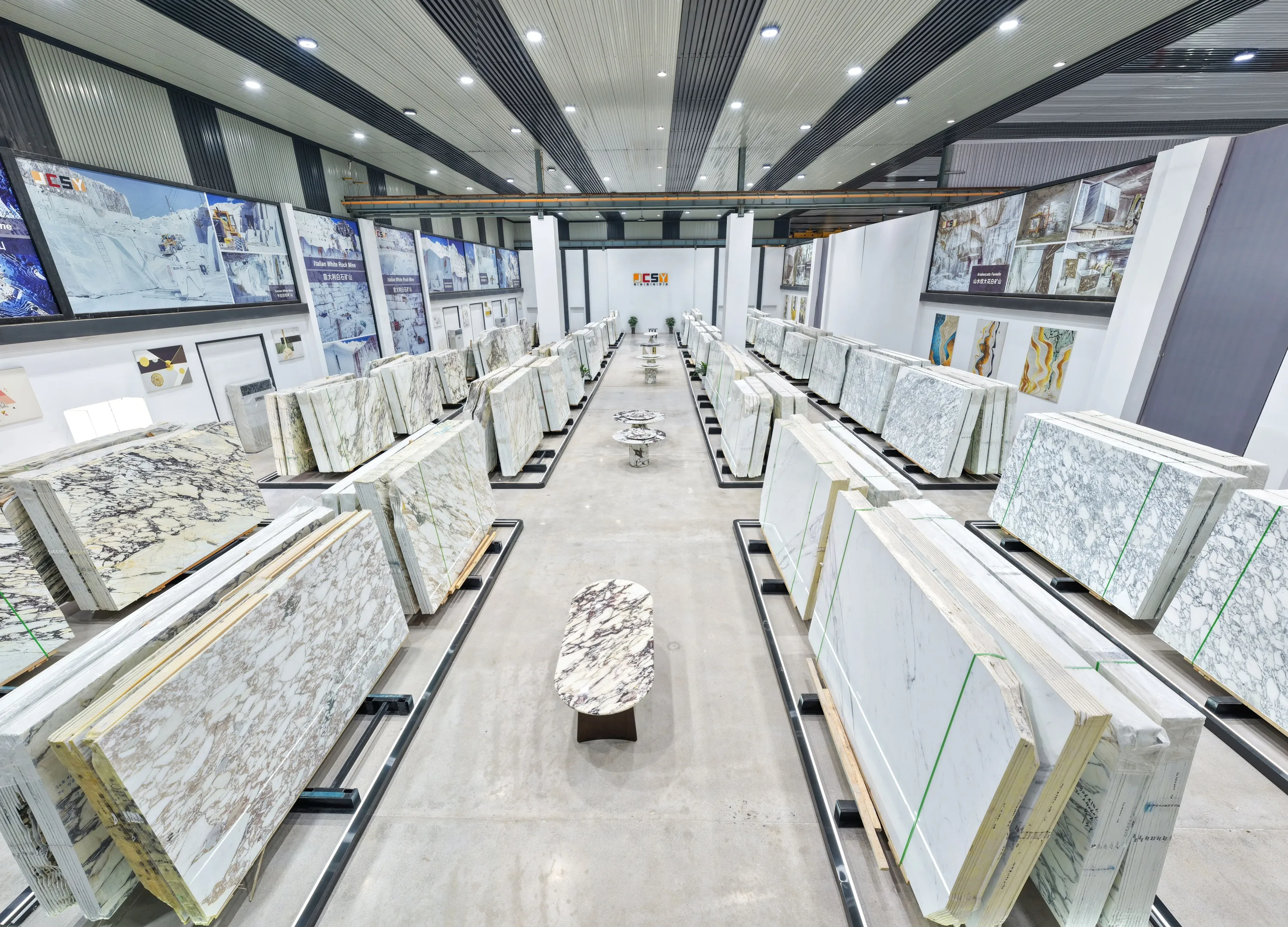
Two names you cannot avoid when choosing Italian white marble: Statuario, and Calacatta Vagli. In photographs they look like cousins; in a room, and on a quotation, they behave quite differently.
The one-line difference
Statuario is whiter, more strongly veined and rarer — a pure white ground crossed by bold grey bands. Calacatta Vagli is warmer and softer — a warm white ground carrying a fine grey-gold web.
The most fundamental difference is really the ground: one is a cool pure white, the other a warm white with a cream tone. That decides the spaces they suit, and the quotation too.
Ground, veining, rarity
| Statuario | Calacatta Vagli |
|---|
| Ground | cool pure white | warm white with a cream tone |
| Veining | bold grey bands, high contrast | fine web, grey with gold |
| Rarity | scarce; the top grade of the Carrara region | supply relatively steady |
| Typical use | feature walls, floors, bathrooms | floors, walls, tops, bathrooms |
Statuario
Its name comes from a fine, close-grained character and a sculptural tradition that continues today. Wikipedia calls it the prize yield of Carrara through millennia — a pure white, historically used for monumental sculpture because it is strong in tension, takes a high polish and holds fine detail.
The ground comes as close to pure white as natural stone does, and the veining arrives as decisive grey bands rather than a faint mist. Because the bands are large and irregular, no two Statuario slabs are alike — which is exactly what makes a book-matched wall so striking, and also what makes consistency across a large order hard.
Use it where the stone is meant to be the subject: a reception wall, a bathroom with presence, a floor running uninterrupted.
Calacatta Vagli
Similar region, different character. The ground is a warm white, and the veining is finer and more even — grey lines touched with gold, spread across the slab like a web.
It lays out more easily and matches more readily over a large area; its warmth suits residential interiors better. Kitchen tops, bathroom tops and continuous floors mostly choose it: what is wanted is a soft, even quality that does not shout, not strong drama.
On price, to be clear
Many people assume Statuario costs more, but the trade has no such consensus. Western retail usually treats top Statuario and top Calacatta as the same highest tier at similar prices; the Chinese consumer market more often prices top Calacatta higher — the phrase “the Hermès of marble” refers, in Chinese, to Calacatta.
The split comes from different comparisons: scarcity of sculpture-grade pure-white blocks against the popularity of big luxury slabs for interiors. And what actually decides price is usually the whiteness and veining grade of that batch of slabs, not the variety name — within one variety the price can vary several times over.
Which to choose
For the whitest white, the strongest contrast, an effect that stops people at the door: Statuario. For warmth, fine even veining and consistency over a large area: Calacatta Vagli. If you are torn, look at the actual slab — a white marble’s character lives in the individual piece, and only a specific bundle tells you what will arrive.
The two can be mixed in one project, but we would not put them side by side in the same sightline, where the difference in ground is obvious. Most designers use Statuario as the main feature and Calacatta in adjacent rooms.
See both online
Our factory in Shuitou, Fujian keeps Statuario and Calacatta Vagli in stock year-round. You can read the full specification of each on the collection page, or browse the actual slabs — each with a scan, its size and bundle reference — in the Cloud Warehouse.