White marble is a natural material, so choosing is not simply “which name do I like”. The points below decide whether the finished room looks like the one in your head, and whether delivery matches the sample.
First, the ground colour
The first question is not which veining you like, but which white you want. Italian whites span a wide range: from the cool, almost blue-white of Bianco Carrara and Statuario, through the neutral white of Arabescato, to the warm, cream-toned whites of Calacatta Vagli and Calacatta Oro.
Warm whites sit comfortably with timber and warm lighting; cool whites read crisper against grey, black and metal. Set the temperature first — everything else follows.
Then the veining
Next, decide how much movement you want. A fine, even web such as Statuario Venato gives a calm, continuous surface that suits large floors. Bold, free patterns such as Arabescato or Arabescato Corchia are closer to a painting, and work best as one feature rather than repeated everywhere.
If you plan to book-match two slabs into one picture, ask for slabs cut from the same block. The trade definition is strict: not only the same block and adjacent, but the two faces that originally faced each other polished, so the patterns are true mirrors — and this is normally done at the sawyer when the block is cut.
The finish
The same stone behaves differently depending on the surface. Polished is the classic choice: it deepens the colour and reflects light, which is why it dominates feature walls and floors in bright rooms. Honed is softer and more forgiving — it hides fingerprints and smudges and is the usual pick for high-traffic floors and bathrooms.
The two cannot be swapped once installed, so decide early. If slip resistance matters, this is the point to settle.
Slab size and layout
Slab dimensions decide how many joints you will see. A wall made from a few large slabs reads as one continuous surface; the same wall made from many small pieces reads as a grid.
Tell us the finished dimensions of the wall or floor and we will suggest a size that keeps the joints where you want them, with a cutting plan that cuts waste. This step also determines how much extra to order: for large-format work we usually suggest 10–15% over the measured area.
Finally, who you buy from
This is often the decisive question. Natural stone cannot be picked from a catalogue page — its character lives in the individual slab.
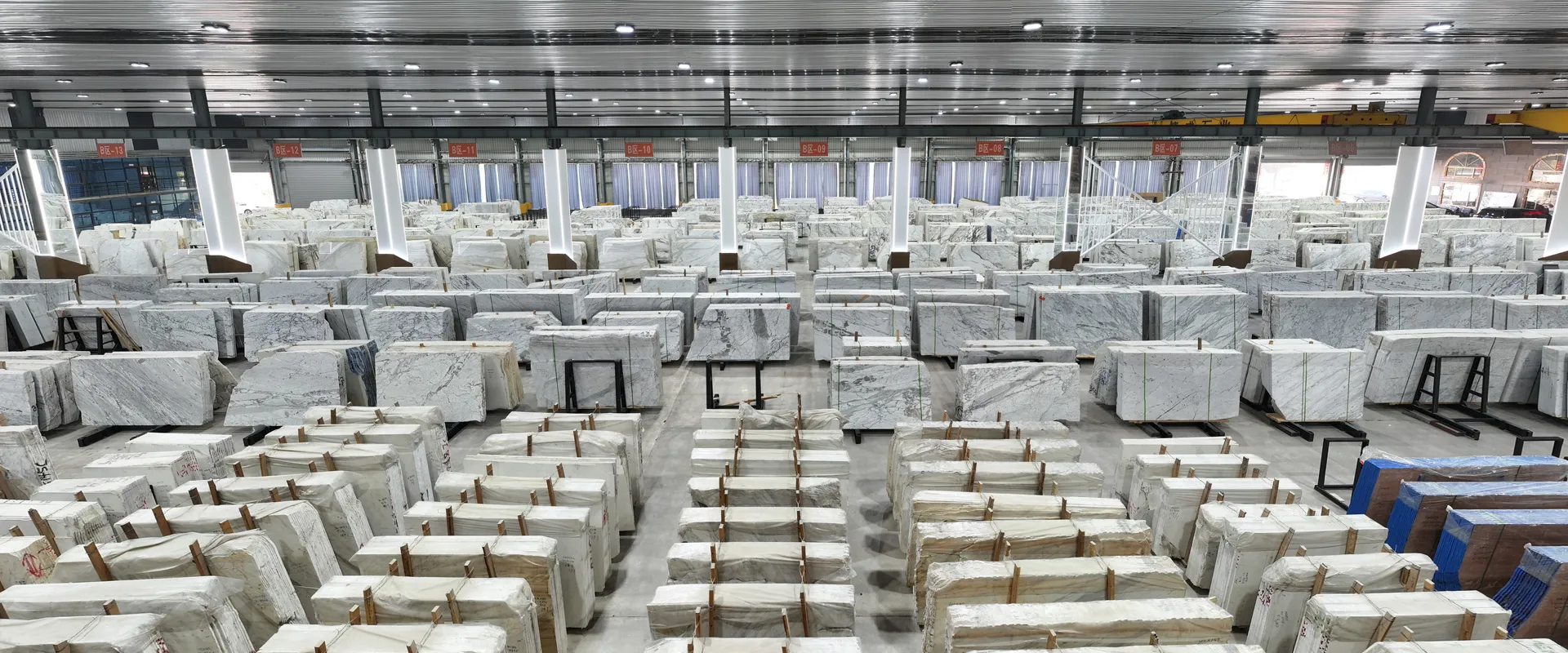
A supplier who shows you the actual slab, scans it, and lets you reserve a specific bundle removes almost all of the risk. It is also why we photograph and publish every slab of our stock in the Cloud Warehouse, with its size and bundle reference: what you approve is what arrives.
Work through them in order — ground, veining, finish, size, supplier — and the choice gets much simpler. If you would like a second opinion on a specific project, send us the layout and the look you are after, and we will suggest two or three varieties and the matching stock slabs.
Full specifications of the nine varieties are on the collection page; actual stock can be browsed slab by slab in the Cloud Warehouse.