This is not a variety pitch. It is the handful of basics we get asked about most, and that the internet most often gets wrong, laid out before you buy.
Almost every day a customer asks the same kind of question. Is this slab actually white enough? Why is the same stone quoted so differently this year than last? Is the “Italian Statuario” I read about online the same thing I saw at another yard last month?
Underneath all of them is one thing: stone is a natural material and the information is uneven, so a single name can cover several different things. Ten minutes on the points below saves a lot of second-guessing later.
Why white marble is so demanding
Start with one number. Marble is mostly calcite, that is calcium carbonate, and it sits at about 3 on the Mohs scale. Granite is 6 to 7, and the quartz aggregate in engineered quartz reaches 7.
So if you cut directly on a white marble worktop, a scratch is close to inevitable. It is not a quality problem, it is the nature of the material. Dragging pans, or leaving water sitting on it, will likewise leave marks over time.
On water absorption, China’s national standard GB/T 19766-2016 (Natural Marble Building Slabs) sets three grades: A at 0.5% or below, B at 0.8%, C at 1.0%, with bulk density respectively above 2.60, 2.55 and 2.50 g/cm³. Dense slabs absorb less; slabs with hairline cracks absorb more. Even within one variety, slabs differ — which is why we keep telling customers to look at the actual slab.
Acid: the fact most often missed
Calcite reacts with acid. The surface is eaten away a little, leaving a matt mark — the trade calls it etching. Lemon juice, wine and vinegar all do it. Granite and quartz are silicates and are far calmer about the same small acid spill.
Here is the part people most often get wrong: a sealer prevents staining but not etching. It blocks liquid from soaking in; it cannot stop acid from reacting with the surface. So “it is sealed, it is fine” is wrong — and that is really the answer to whether white marble belongs on a kitchen worktop.
Carrara is a district, not a stone
The Apuan Alps in northern Tuscany, around Massa and Carrara, have been quarried since Roman times, when the stone was called marmor lunense. Wikipedia puts it neatly: more marble has come out of Carrara than from any other place on earth, from over 650 quarries, about half of them now abandoned.
Within the trade it is graded by pattern. The largest volume, the base grade, is Bianco Carrara, in grades C and CD; above that come Bianco Venatino and Statuarietto; the pricier ones include Calacatta Gold, Calacatta Borghini, Calacatta Macchia Vecchia and Arabescato Cervaiole. Statuario, which Wikipedia calls the prize yield of Carrara, is the pure white — historically used for monumental sculpture, because it is strong in tension, takes a high polish and holds fine detail.
One thing worth being clear about: Statuario, Calacatta and Arabescato are pattern grades, or trade names, within one district — not separate origins. And a lot of stone labelled Calacatta or Statuario actually comes from Turkey or Brazil. These are trade names, not geological or geographic certifications. Go by the actual quarry and slab number.
The names are messier than you think
Trade naming runs to two families plus a base grade. The Calacatta family is a bright white ground with bold veining, usually gold or amber: Calacatta Vagli, Calacatta Gold (which is Calacatta Oro; oro is Italian for gold), Calacatta Borghini, Calacatta Macchia Vecchia, and the purple-veined Calacatta Viola. The Arabescato family is grey-veined and mostly named after Apuan quarry locations: Arabescato Corchia, Cervaiole, Vagli, Faniello. Bianco Carrara and Bianco Venatino are the base grade.
One trap worth flagging: Arabescato Orobico sounds similar, but it comes from Lombardy, is a dark grey breccia, and has nothing to do with Carrara.
Chinese naming is messier still. The same term has been pointed at two different English varieties in public references, and a widely used Chinese name officially corresponds to Arabescato Faniello. None of that stops you buying, but it does mean: do not order from a Chinese name alone.
There is also a class of names sellers invent. “Bulgari” is one example — there is no such marble variety in any authoritative reference, and on B2B platforms pink, red, blue, black and white stones are all called Bulgari, sintered slabs and porcelain included. It borrows a luxury brand’s name and has no geological definition. Fine as a shop’s own product name, but not as an industry variety. The white-ground, purple-grey and gold look usually sits in the Calacatta Viola family.
Surface finishes: three words, used correctly
Three finishes are standard internationally. Polished is the mirror finish — China’s national standard calls it “mirror (JM)”. Honed is smooth but not reflective; English sources call it the original matte surface, better for grip and for hiding marks. Antiqued is flamed and then wire-brushed several passes, leaving texture that is not sharp to the touch.
One Chinese translation trap to dodge: in the Chinese stone trade, “拉丝” usually means grooving — cutting straight channels into the surface — and that is not the same as brushed. Translate brushed as “拉丝面” and the fabricator will think you want grooves. The closer term is 布纹面, brushed; where it feels like leather, 皮革面, leathered.
Book-matching: a stricter definition than people assume
Book-matching has a hard definition in the trade: two slabs from the same block, adjacent to each other, polished on the two faces that originally faced each other, so the pattern is a true mirror. The Natural Stone Institute is blunt about it — this is normally done at the sawyer when the block is cut, not added later at a workshop. Doing it later means back-polishing one slab: more cost, and the result is not guaranteed.
Two related terms. Letting the veining run across a seam is vein-matching, common on a waterfall countertop edge. Four pieces forming one complete pattern is diamond or quad matching.
Price: learn the tiers, not the numbers
The variety name is only the door to the price. What actually prices it is whiteness, how prominent and how even the veining is, whether there are yellow or grey patches, whether there are cracks, and what supply and demand are doing at the time. One variety can therefore run from cheap to very expensive. The tiers look roughly like this:
| Tier | Representative varieties |
|---|
| Highest | top Statuario, Calacatta Borghini / Gold |
| High | Arabescato family, ordinary Calacatta |
| Mid | Statuario Venato, Bianco Venatino, Statuarietto |
| Base (high volume) | Bianco Carrara C / CD |
| Lower | Bardiglio and ordinary export grades |
One thing has to be said plainly: both claims exist in the trade — that top Statuario costs more, and that top Calacatta does. Western retail usually treats Statuario and Calacatta as the same tier at similar prices (backed by a named industry figure and 2021 dollar quotes); the Chinese consumer market more often prices top Calacatta higher, and the phrase “the Hermès of marble” refers, in Chinese, to Calacatta. The split comes from different comparisons: scarcity of sculpture-grade pure-white blocks versus the popularity of big luxury slabs for interiors.
A word on shipping
Common slab thicknesses are 1.6, 1.8, 2 and 3 cm (US standards are 19 and 32 mm); slabs commonly start at 2400×1200 mm and go up to 3000×1500 and 3200×1600. Blocks are usually priced by volume (m³) or weight (tonne), slabs by square metre. Packing is fumigated wooden crates with steel straps, compliant with ISPM 15 — and never straw rope on white stone, it causes yellowing. Because stone is heavy, it usually ships in 20-ft containers; 40-ft tends to exceed weight limits, and slabs over 1.8 m tall are better in an open-top.
How we work
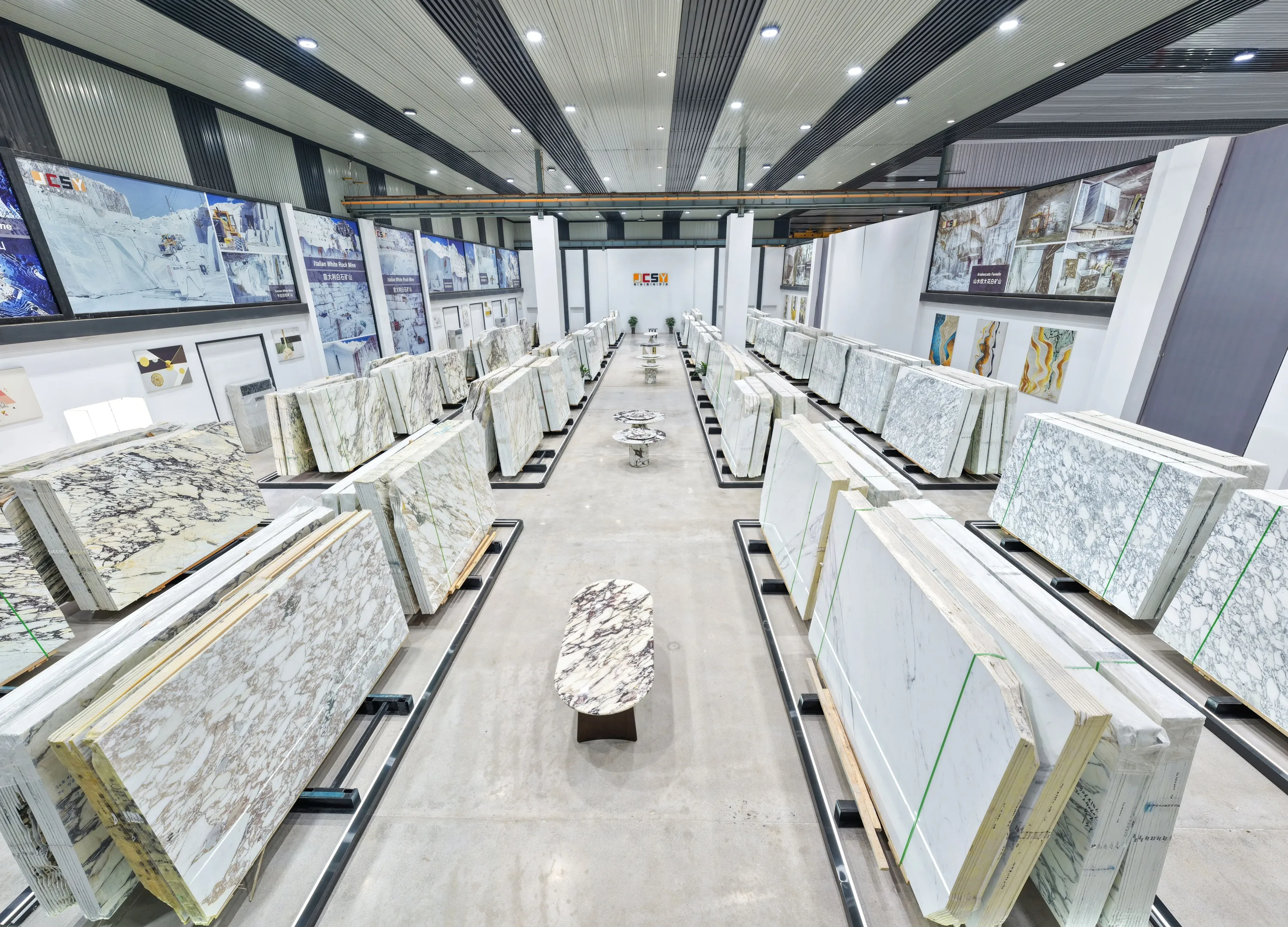
Jiecheng Stone deals in Italian light-luxury white marble. Blocks come straight from partner quarries in the Carrara region (Volakas White from Greece) and are sawn, polished and resined at our own 80,000 m² factory in Shuitou. One habit we have kept: every slab is scanned into the Cloud Warehouse with its texture, size and bundle reference, so you can check piece by piece before shipping. That is more concrete than any claim about “grade”.
Sources